A
- Adams, J[ohn]
- Aesop
- Aikin, John
- Alciato, Andrea
- Alemán, Matheo
- Almack, Edward
- Ariosto, Lodovico
- Ascham. Roger
- Austen, Ralph
— Adams, J[ohn], An Essay Concerning Self-Murther. Wherein is endeavour’d to prove, That it is Unlawful according to Natural Principles (London: Printed for Tho[mas] Bennet, at the Half-Moon, in St. Paul’s Churchyard, 1700). Bookplate with the armorial crest of the Jolliffe family on the upper pastedown; bookplate ‘From the John Donne Collection of Hamilton Tyler’ on the lower pastedown. 8vo. Wing A483.
Adams (1662-1720) is identified on the title page as ‘Rector of St Alban Woodstreet and Chaplain in Ordinary to His Majesty [i.e. William III]’. The treatise is a close examination of Biathanatos (see Donne 1648, 1700) which is also mentioned in Ezra Pierce, Discourse of Self-Murder (1692). Both Donne and Adams are cited in John Cockburn, Discourse of Self-Murder (1716), and Biathanatos is discussed again in Charles Moore, A full enquiry into the subject of suicide (1790). See also Geoffrey Keynes, A Bibliography of John Donne (1968), pp. 91-2; Booksellers’ and Auction Catalogues: Edwards (List 2, no. 1)
— Aesop, Fables of Aesop and Other Eminent Mythologists: With Morals and Reflexions, by Sir Roger L’Estrange, Kt. (London: Printed for R. Sare, T. Sawbridge, B. Took, M. Gillyflower, A. and J. Churchil, and J. Hindmarsh, 1692). Engraved frontispiece portrait of L’Estrange by Robert White after Sir Godfrey Kneller; one further engraving of Aesop surrounded by the animals of his fables, also from a picture by Kneller. Full calf, blindstamped border to front and rear boards, five raised bands and new morocco title label to spine. Inscription to front pastedown: ‘Eliza Jacob, Her Book, given me by Dear Mr Jacob, Oct 19th 1692’. 4to. 1st edn. ESTC R6112.
Preface; The Life of Aesop; An Alphabetical Table, referring to the number of the respective Fables; The Fables of Aesop etc. [Fable; the Moral; Reflexion], numbers 1-201; The Fables of Barlandus, 202-14; The Fables of Anianus, 215-52; The Fables of Abstemius, 253-351; The Fables of Poggius, 352-73; Miscellany Fables, 374-83; A Supplement of Fables out of Phaedrus, Avienus, Camerarius, Neveletus, Aphthonius, Babrias, Babrias, Abstemius, Alciatus, Boccalini, Baudoin, De la Fontaine, Aesope en Belle Humeur, Mestier, 384-500.

Frontispiece to L’Estrange, Aesop’s Fables (1692)
L’Estrange’s source is what he calls in the preface, ‘the Common School-Book, as it stands in the Cambridge and Oxford editions of it, under the title of Aesopi Phrygis Fabulae: una cum Nonnullis Variorum Autorum Fabulis Adjectis’, and fables 1-383 come from this. But he has also supplemented it with material from other writers, including some modern fabulists, the most famous being La Fontaine, to round it up to 500 fables. L’Estrange also added the ‘Reflexions’, following Jean Baudoin, whose Aesop was first published in 1631.
Related titles: Aesopi Phrygis vita et fabulae (1545), TypFP.B45SA; La Fontaine, Fables choisies (1700), r17 PQ1808.A1D00; Sir Roger L’Estrange, Aesop at the Bell-Tavern in Westminster (1711), s AC911.P5 [imitations of Aesop possibly by William Pittis].
— [Aesop] Favole Esopiane di Luigi Grillo (Londra [London]: G. Polidori and James Wallis, 1800)
Grillo’s Italian versions of Aesop’s Fables were first published in Paris in 1789 and in London by Molini in 1795. The entry for the British Library copy of the 1800 edition gives no publication details. The editor’s preface says that Gay and La Fontaine are the best models for writers of verse fables and that Grillo is imitating La Fontaine.
— Aikin, John, Letters to a Young Lady on a Course of English Poetry (London: J. Johnson, 1804).
Aikin was a doctor with literary interests, who edited the Monthly Magazine from its launch in 1796. He was the brother of Anna Letitia Barbauld and collaborated with her on a programme of family reading called Evenings at Home (6 vols., 1792-5), which was widely translated. The present volume is mainly concerned with eighteenth-century poetry, but there is discussion of Spenser, Milton and Cowley, and the relative merits of blank verse and rhyme.
Related titles: Essays literary and miscellaneous (1811), s PN1136.A4 (and various other works by Aikin).
— Alciato, Andrea, Emblemata, denuo ab ipso Autore recognita, ac, quae desiderabantur, imaginibus locupletata [ed. Barthélemy Aneau] (Lyons: Macé Bonhomme for Guillaume Rouillé, 1551). Title within woodcut architectural border. 211 woodcut emblems, each page within an elaborate woodcut frame. Modern vellum with manuscript title to spine. USTC 150865 or 154134.
Copies recorded in UK libraries: British Library; National Library of Scotland.
Alciato’s emblems were first published at Augsburg in 1531, but their printing moved to France from 1534. This reprints the edition of 1550, which was the first to include all the emblems with the exception of the so-called ‘obscene emblem’. In this copy the emblems on pages 161-2 are printed the wrong way round.
Latin emblem titles in English by page number: [Dedicatory emblems] 7. To the illustrious Maximilian, Duke of Milan. The arms of the Duchy of Milan; 8. Milan; 9. Never procrastinate; [God, or Religion] 10. Joy is to be found in God; 11. The wisdom of man is folly with God; 12. False religion; 13. Not for you, but for religion; 14. Go where heaven calls; 15. Good faith; 16. Alliances; 17. Silence; 18. Keep counsels secret; 19. Do not yield even to torture; [Wisdom] 20. Wisdom and courage defeat Chimaera [i.e. the powerful and deceivers]; 21. Vigilance and protection; 22. Live soberly; do not believe readily; 23. What thing incumbent on me has been left undone; 24. The wise – a problem; 25. Wise head, close mouth; 26. Making good speed; 27. Caught!; 28. Girls must be guarded; 29. Wisdom increased by wine; 30. The wise abstain from wine; 31. A statue of Bacchus; 33. Grass; [Justice] 34. Injure no-one, either by word or deed; 35. At long last justice wins the day; 36. Even the fiercest are tamed; 37. Show gratitude; 38. Integrity; 39. The good have nothing to fear from the rich; [Fortitude] the mark of the brave; 41. Hold on and hold off; 42. Unable to flatter; 43. Stand firm against pressure; 44. All that is mine I carry with me; [Concord] 45. A symbol of concord; 46. Concord; 47. Concord is insuperable; 48. One can do nothing, two can do much; 49. The firmest things cannot be uprooted; [Hope] 50. Hope at hand; 51. A picture of hope; 53. Getting better every day; 54. Do not hope for what is not allowed; 55. Chastity; [Vices] 56. Treachery; 57. Deceivers; 58. Treachery against one’s own kind; 59. Evil speaking; 60. Those who harbour cut-throats; 61. Flatterers; 62; Others’ property should not be entrusted to a person who has once squandered his own; [Folly] 63. Rashness; 64. Fury and madness; 65. The reckless; 66. Those who venture on what is beyond their powers; 67. The impossible; 68. Cuckoos; 69. The bat; 70. Another [on the bat]; 71. Rage; 72. One who brings about his own downfall; 73. Stupidity; 74. Heedlessness is the mother of poverty; [Pride] 75. Pride; 76. Effrontery; 77. Philautia – Self-satisfaction; 78. Garrulity; [Envy] 79. Envy; [Licentiousness] 80. Licentiousness; 81. The wealth of the dissipated; 82. The courtesan’s tomb; 83. Those who give their affection to whores; 84. Beware of whores; 85. A charm against love; 86. Immune to Cupid’s dart; 87. Wantonness – A problem; [Idleness] 88. Idleness; 89. Away with idleness; 90. Easily deflected from the right course; 91. Good for nothing; [Avarice] 92. Avarice; 93. On the avaricious; 94. Courtiers; 95. Disgusting people; 96. Those who grow rich out of public misfortune; 97. On the avaricious; or being treated better by strangers; [Greed] 98. Gluttony; 99. A representation of Ocnus. On those who give to whores what should be turned to good use; 100. Professional spongers; 101. A small kitchen will not satisfy two gluttons; 102. Caught by greed; 103. Against a noisy gluttonous fellow; 104. Professors’ nicknames; [Nature] 106. The power of Nature; 107. Art assisting Nature; 108. On youth; 109. The four seasons; [Astrologia] 110. Nestor’s cup; 112. What lies above is none of our business; 113. Against astrologers; 114. Those who contemplate the heights come to grief; [Amor] 115. Love, the all-powerful emotion; 116. The power of love; 117. Love’s might; 118. A scholar in the toils of love; 119. Anteros, i.e. love of virtue; 120. Anteros, Love of virtue, conquering the other love; 121. Sweetness turns at times to bitterness; 122. Something more or less the same from Theocritus; 123. A statue of love; 125. Forgetting one’s country; 126. Sirens; 127. An old man in love with a girl; 128. On colours; [Fortune] 129. Good fortune attendant on virtue; 131. Fortune triumphant over virtue; 132. Poverty prevents the advancement of the best of abilities; 133. Opportunity; 134. Sudden terror; 135. Praising the wrong things; 136. Transitory success; 137. One’s loss is another’s gain; 138. Begin with good auspices; 139. Nothing left; 140. Ill gotten, ill spent; 141. Misfortune is always at hand; 142. Remedies are hard, damage is easy; [Renown] 143. Lasting renown won through tribulation; 144. Immortality won through literary pursuits; 145. The tomb of Iovanne Galeazzo Visconti, first Duke of Milan; 146. The best citizen; 147. Achievers have an immortal name; 148. High-born and noble; 149. The twelve labours of Hercules; 151. Bastards; 152. Inferiority; 153. On those who turn traitor; 154. Competing on unequal terms; 155. Sent by Albutius to Alciato urging him to withdraw from the Italian troubles and take up a teaching post in France; [The Ruler] 156. The Prince caring for the safety of his subjects; 157. On the senate of a good prince; 158. What Christ does not receive, the exchequer seizes; 159. A wealthy ruler means poor subjects; . [The State] 160. Counsellors of princes; [The Ruler] 161. Clemency in a ruler; [The State] 162. The nation’s health; 163. The republic restored to freedom; [Life] 164. On human life; 165. Sometimes money must be spent to purchase safety; [Death] 166. Do not wrestle with the dead; 167. Death and Love; 168. On a beautiful woman, dead before her time; 169. Untimely death; 170. Terminus; 171. The rich man’s legacy; [Friendship] Friendship lasting even beyond death; 173. Mutual help; 174. Help never failing; 175. The Graces; [Enmity] 177. Against his detractors; 178. Antagonism that achieves nothing; 179. Misfortune caused by a bad neighbour; 180. One who perished through the savagery of his own people; 181. The gifts of enemies are no gifts; 182. Beware of even the weakest foe; 183. Weakness is vulnerable; 184. Terrifying even after death; [Retribution] 185. Just recompense; 186. Just revenge; 187. The one who urges wrongdoing is as guilty as the one who does the wrong; 188. One sins and another is punished; 189. The madman’s sword; [Peace] 190. Peace; 191. Peace succeeding to war; 192. Prosperity as the result of peace; [Learning] 193. It is wicked for scholars to wrangle with other scholars; 194. Eloquence is superior to strength. 195. Eloquence is hard; 196. The oldest things are all invented; 197. Insignia of poets; 198. The gods care for music; 199. The letter kills but the spirit gives life; 200. Sayings of the Seven Sages; [Ignorance] 202. Ignorance must be done away with; 203. Intelligence matters, not beauty; 204. The stupid rich man; [Marriage] 205. On faithfulness in a wife; 206. Respect is required in marriage; 207. Fruitfulness bringing its own destruction; 208. Love of one’s children; 209. Honour from children towards parents; 210. A woman’s reputation, not her beauty, should be known to the world; 211. A statue of Modesty; 212. A woman married to a diseased man; [Trees] 213. The cypress; 214. The oak; 215. The willow; 216. The fir tree; 217. The spruce tree; 218. The quince; 219. Ivy; 220. The holm-oak; 221. The citron; 222. The box-tree; 223. The mulberry; 224. The almond; 225. The laurel; 226. The white poplar.

Prudentia from Alciatio, Emblemata (Lyons, 1551)
Translations are from Andrea Alciato, Emblemata [Lyons, 1550], translated and annotated by Betty I. Knott with an introduction by John Manning (Aldershot: Scolar Press, 1996). See also the Glasgow University Emblem Website.*
Related titles: Théodore de Bèze, Icones (1580), TypSwG.B80LB; Sebastián de Covarrubias Orozco, Emblemas morales (1610), r17 PQ6398.H78.
— Alciato, Andrea, Emblemata, cum commentariis, quibus emblematum omnium aperta origine, mens authoris explicatur, & obscura omnia obscura dubiaque illustrantur per Claudium Minoem (Paris: Hieronymus de Marnef and the widow of Gulielmus Cavellat, 1583). Bound in later gilt calf. Signature of D. L. Cumming. Early annotations and underlinings to title page and a few other leaves. 8vo.
Not listed in USTC, but a 1573 printing by de Marnef and Cavellat (not his widow) is listed in Henry Green, Andrea Alciati and His Books of Emblems: A Biographical and Bibliographical Study (1872), number 84, which represents the first appearance of the commentary by Claude Mignault (Minos). Mignault’s is the most important and influential of the various Alciato commentaries, with his French translation following in 1584, printed by Jean Richer.
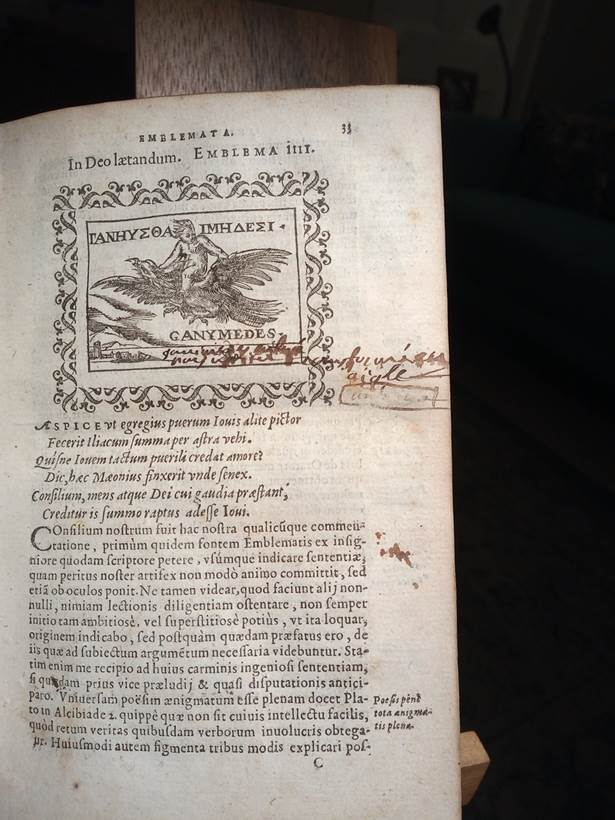
Jupiter and Ganymede from Alciato, Emblemata (1583)
There is a translation of the prefatory matter (the letter to the reader and the discussion of symbols) and the commentary on ‘In deo laetandum’ by Denis Drysdall in Theoretical Writings on the Emblem: A Critical Edition.
https://www.emblems.arts.gla.ac.uk/Mignault_intro.html
There is some annotation on the title page, sigs. B4v-C1r, and Tt8v, but mostly not very legible.
— Alemán, Matheo, The Rogue: or the Life of Guzman de Alfarache [trans. James Mabbe] (London, printed for Edward Blount, 1623). In two parts with separate title pages and pagination. Folio in sixes. Nineteenth-century half calf over marbled boards. Part one and some of part two printed by Eliot’s Court Press; part two (quires (**), Hh-Bbb) printed by George Eld. Armorial bookplate of Merthyr Guest. STC 289. ESTC S106804. £1500

Imprint of Mabbe’s The Rogue (1623)
1st edition. There were two issues in 1623, though one is dated 1622, with no significant textual variants between the two. Alemán’s work first appeared in 1599 as Guzmán de Alfarache and was the most influential of the picaresque novels, with multiple seventeenth-century reprintings of the Mabbe translation and imitations such as George Fidge’s The English Gusman (1652) and Richard Head’s The English Rogue (1665). Mabbe’s translation appeared in the same year as the Shakespeare 1st folio and from the same publisher, Edward Blount. It also carries commendatory verses from Ben Jonson and Leonard Digges, both of whom contributed similar verses to the 1st folio, as did Mabbe himself. Mabbe was a fellow of Magdalen College, Oxford, and was in Spain from 1611 to 1616 in a diplomatic capacity, so he must have met Shakespeare before 1611. Description of this copy by Christopher Edwards loosely inserted.
See also Booksellers’ and Auction Catalogues: Edwards (List 69, no. 56 for a large-paper copy; List 80, no. 42 [my copy]).
Related titles: Matheo Alemán, The Rogue, 4th edn (1656), TypBL.C56BA; Cristóbal de Fonseca, Devout Contemplations [trans. James Mabbe] (1629), TypBL.C29IF.
— Almack, Edward, Bookplates (London: Methuen & Co., 1904)
— Ariosto, Lodovico, Orlando Furioso. Revisto et ristampato, sopra le correttioni di Ieronimo Ruscelli (Lyon: Guillaume Rouillé, 1570). 12mo. Later calf with red title label, gilt endpapers and blue edging. Allegorical woodcut vignettes throughout the text. USTC 158308.
A cheap, pocket Ariosto, though still with the illustrations which had become an integral part of the poem. Vincenzo Valgrisi’s edition of 1558 (see Related titles) had introduced Ruscelli’s commentary and full-page illustrations and these appear in a reduced form here. St Andrews has a number of sixteenth-century editions of Ariosto, all printed in Venice; this is a French printing.

Astolpho and his horn from Orlando Furioso canto 20 (1570)
Copies recorded in UK libraries: British Library; Oxford: Bodleian Library, All Souls (Codrington), Corpus Christi College, Magdalen College, Department of the History of Art, Sackler Library; Cambridge: Trinity College.
Related titles: Ariosto, Orlando Furioso (Venice: Giolito de’ Ferrari, 1543); Orlando Furioso (Venice: Valgrisi, 1558), For PQ4270.A8B58; Orlando Furioso (Venice: De Franceschi, 1584), TypIV.B84FA; Le Satire (Venice: Bindoni, 1544), bound with Rime (Venice, 1552), TypIV.B52XA; Comedie (Venice Giolito de’ Ferrari, 1562), Typ IV.B62GA
— Ascham, Roger, The Scholemaster: shewing a Plain and Perfect Way of Teaching the Learned Languages, revised by James Upton (London: Printed for W. Innys, at the West End of St. Pauls; and S. Birt, in Ave-Mary Lane, 1743).
First published in 1711, Upton’s revision of Ascham kept his work current for a century, being reprinted in 1743 (the present copy), 1761 and 1815. Upton was a Fellow of King’s College, Cambridge and then a schoolmaster and clergyman in Somerset. He had also published an edition of Theodore Goulston’s Poetics of Aristotle (1623) in 1696. His second son John produced an edition of The Faerie Queene.
Related titles: The Schoolmaster (1711), Don PR2201.S3D11.
— Austen, Ralph, A Treatise of Fruit-Trees, Shewing the manner of Grafting, Planting, Pruning, and Ordering of them in all respects according to new and easy rules of Experience … The second edition; with the addition of many new Experiments, and Observations (Oxford: Printed by Henry Hall Printer to the University, for Thomas Robinson, 1657). 4to. Early calf binding rebacked with red morocco label. Lacking the extra engraved title page (the typographical title page is present). Wing A4239; ESTC 207480.
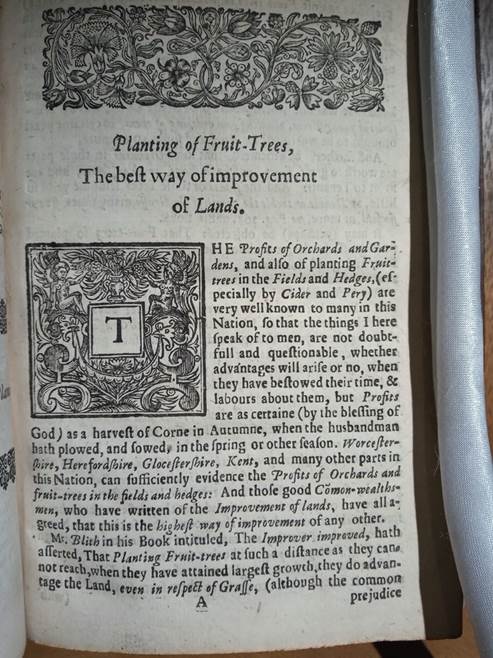
From Austen’s Fruit-Trees (1657)
Ralph Austen was a horticulturalist and religious radical from Leek in Staffordshire, who believed that fruit growing could contribute to the establishment of the kingdom of heaven on earth. Part of the Samuel Hartlib circle, he also believed that the government should support new plantations supplied by his nurseries and following the methods outlined in his textbooks. Although no official sponsorship followed, the three editions of the Treatise of Fruite-Trees 1653, 1675, 1665 did increase demand. Austen propgagated 75 varieties of fruit-bearing trees and was a great advocate of the benefits of cider. James Grantham Turner describes the Treatise as ‘as much a revolutionary manifesto and a spiritual autobiography as it is a technical handbook. The horticultural part comprised one of the most systematic and detailed treatments of the subject published in England up to that time, and was preceded by an enthusiastic list of proposals to make England “another Canaan, flowing with Milke and hony” (Austen, Treatise, fol. 2v)’. The Treatise is sometimes followed by a radical devotional exercise, The Spirituall Use of an Orchard or Garden of Fruit-Trees (expanded to book length in 1657). It is not included in the present copy and was dropped in 1665 on Boyle’s advice.
See also James Grantham Turner, ‘Ralph Austen’ in ODNB.
Related titles: Leonard Mascall, A Booke of the Art and Manner how to Plant and Graffe all sorts of Trees (1592), TypBL.B96.EH