B
— Bacon, Francis, The Essayes or Counsels, Civil and Morall, of Francis Lo. Verulam, Viscount st Alban. Newly enlarged (London: Printed by John Haviland, for Hanna Barret, and Richard Whitaker, and are to be sold at the signe of the Kings head in Pauls Church-yard, 1625). 1st edition, 1st state, of the complete and final version of the Essays, published in the year before Bacon’s death. 4to. Bound in contemporary calf, much rubbed, and with a nineteenth-century reback. STC 1147; ESTC S124226.

From Bacon’s Essays (1625) annotated by John Cranch
Ownership signature of the painter John Cranch dated 1796 on the title page. Extensive quotations and annotations on the preliminary leaves and in the margins of the text in the same hand. Later inscription of Henry Holden 1873. Present bookseller’s description and an older notice loosely inserted. Cranch was a major influence on the young Constable, though perhaps less as a painter and more in terms of general advice and prescriptions for reading; see James Hamilton, Constable: A Portrait (London: Weidenfeld and Nicolson, 2022)
Related titles: Of the Advancement and Proficiencie of Learning (1605), TypBL.C05PB; Of the Advancement and Proficiency of Learning [translation from expanded Latin version] (1640), TypBO.C40LB; The Historie of the Reigne of King Henry the Seventh (1629), TypBL.C29HB.
— Bacon, Francis, The Essayes or Counsels, Civill and Morall of Francis Lo. Verulam, Viscount St Alban. Newly enlarged. With Of the Colours of Good and Evill, a Fragment (London: John Haviland, in the little old Bayly, 1632). Rebound in 1953 in brown goatskin, with the original calf sides re-laid. The spine with raised bands, lettered direct. There is an explanatory note about the binding on the lower pastedown.
The ESTC records this as a page-for-page resetting of the 2nd edition of 1629; however, the STC notes that there are numerous variations among copies of both the 1625 and 1629 editions.
The definitive edition of Bacon’s work containing 58 essays was published in 1625, and this is the third edition of that version. The Colours of Good and Evil was included with the Essays from the first edition of 1597 onwards. STC 1150; Gibson 16.

from Bacon, Essayes (1632)
— Bacon, Francis, Sylva Sylvarum: or A Naturall Historie. In Ten Centuries. Written by the Right Honourable Francis lo. Verulam, Viscount St Alban (London: Printed by J. H[aviland and Augustine Mathewes] for William Lee at the Turkes Head in Fleet Street, next to the Miter, 1628). With New Atlantis (separate title page; no date; [printed by A. Mathewes]. 2nd edn. STC 1170. Inscription on title page: ‘Elizabeth Bentley May 10, 1780’ and at the foot of the page ‘Elizabeth Bentley April 18, 1825’. Further inscription with the date 1869.

Frontispiece engraving showing two Corinthian columns and between them a sphere with the inscription ‘Mundus intellectualis’ resting on a cartouche which frames the title. The design is similar to the title page of Bacon’s Instauratio magna (1620), designed by Simon de Passe, and ultimately derives from the impresa of the Emperor Charles V with its two pillars and the motto plus oultre. Frontispiece laid down; the date of 1629 on the plate corresponds with the 1628 printing, as listed in STC. Title page and following leaf reattached.
Sylva Sylvarum was published shortly after Bacon’s death in 1626 by his chaplain William Rawley and consists of 1000 ‘experiments’, grouped into ten ‘centuries’. ‘Experiment’ is not a term Bacon normally uses to describe his scientific investigations, so this may be Rawley’s word. All early editions of the Sylva, including the present copy, are accompanied by the New Atlantis, and together they made this the most popular of all Bacon’s works in the seventeenth century.

Title page for the 2nd edition of the New Atlantis (1628)
See also Alastair Fowler, The Mind of the Book: Pictorial Title Pages (Oxford, 2017), 128-9.
Related titles: Francis Bacon,Sylva sylvarum (1664), AlcC64BA.BL.
— Bandello, Matteo, Novelle di Matteo Bandello, 9 vols. (Milano: Giovanni Silvestri, 1813-14). Engraved portrait frontispiece by Luigi Rados (1773-1840). Prefatory matter: notice by the editors of the scope and aims of the series in which this appears, together with a list of the other authors published; dedication by Gaetano Poggiali to Sir George Mathew from the edition published at Livorno, 1791-3 (with a false London imprint); life of Bandello by Count Giammaria Mazzuchelli (1707-65).

Bookplate of Herbert of Highclere. This is the Earl of Carnarvon, whose family seat is Highclere Castle where most of Downton Abbey was filmed.
Related titles: Histoires tragiques, trans Boaistuau (1559), TypFP.B59PB; Continuation de Histoires tragiques, trans. Belleforest (1560), TypFP.B59PB.
— Bandello, Matteo, The Novels of Matteo Bandello, trans. John Payne, 6 vols. (London: privately printed for the Villon Society, 1890)
The earliest English translations of Bandello appear in William Painter, The Palace of Pleasure (1566), STC 19121. They are as follows: Part 1, Tale 10 [Novel 40, fol. 107: ‘Mahomet and Irene’]; Part 1, Tale 22 [Novel 41, fol. 112: ‘The Lady Falsely Accused’]; Part 1, Tale 42 [Novel 42, fol. 125: ‘Didaco and Violenta’]; Part 2, Tale 12 [Novel 43, fol. 135: ‘The Lady of Turin’]; Part 2, Tale 26 [Novel 46, fol. 258: ‘The Countess of Salisbury’]; Part 2, Tale 27 [Novel 44, fol. 20: ‘Aleran and Adelasia’]; Part 2, Tale 44 [Novel 45, fol. 226: ‘The Duchess of Savoy’]. The following stories from Bandello appear in the ‘Second Tome’ of the Palace (1567), STC 19124: Part 1, Tale 2 [Novel 4, fol. 11: ‘Ariobazarnes’]; Part 3, Tale 5 [Novel 5, fol. 32: ‘Aristotimus the Tyrant’]; Part 1, Tale 41 [Novel 7, fol. 49: ‘Sophonisba’]; Part 1, Tale 56 [Novel 9, fol. 61: ‘A Lady of Hidrusa’]; Part 1, Tale 36 [Novel 10, fol. 65: ‘The Empress Faustina’]; Part 1, Tale 45 [Novel 21, fol. 140: ‘Anne, Queen of Hungary’]; Part 2, Tale 15 [Novel 22, fol. 155: ‘Alexander de Medice and the Miller’s Daughter’]; Part 1, Tale 26 [Novel 23, fol. 169: ‘The Duchess of Malfy’]; Part 1, Tale 4 [Novel 24, fol. 195: ‘The Countess of Celant’]; Part 2, Tale 9 [Novel 25, fol. 218: ‘Romeo and Juliet’]; Part 1, Tale 15 [Novel 26, fol. 247: ‘Two Ladies of Venice’]; Part 3, Tale 17 [Novel 27, fol. 268: ‘The Lord of Virle’]; Part 1, Tale 21 [Novel 28, fol. 292: ‘A Lady of Boeme’]; Part 1, Tale 27 [Novel 29, fol. 309: ‘Diego and Ginevra’]; Part 1, Tale 46 [Novel 30, fol. 350: ‘Salimbene and Angelica’]; Part 1, Tale 35 [Novel 32, fol. 391: ‘Camiola and Roland’]; Part 1, Tale 55 [Novel 33, fol. 397: ‘The Lords of Nocera’]; Part 1, Tale 57 [Novel 34, fol. 417: ‘The King of Morocco’].
Geoffrey Fenton, Certaine Tragicall Discourses (1567) is derived entirely from Bandello via the French translations of François de Belleforest.
See also William Painter, The Palace of Pleasure, ed. Joseph Jacobs, 3 vols. (New York: Dover, 1966) for a list of sources, analogues, and early modern plays based on Bandello tales in Painter; Lorna Hutson, The Usurer’s Daughter (London: Routledge, 1994); R. W. Maslen, Elizabethan Fictions (Oxford: Clarendon Press, 1997). Cf. also Marguerite de Navarre.
Related titles: William Painter, The Second Tome of the Palace of Pleasure (1567), TypBL.B67BP (and two further copies).
— [Bath, Michael] Visual Words and Verbal Pictures: Essays in Honour of Michael Bath, ed. Alison Saunders and Peter Davidson (Glasgow: Glasgow Emblem Studies, 2005). Mike Bath was my colleague at Strathclyde University where I was a Lecturer from February 1977 to August 1979. The biography describes how he reinvented himself from being a Thomas Hardy specialist to emblem scholar and expert in the Scottish decorative arts (especially painted ceilings). There is an essay on Gardyne’s House in Dundee by Peter Davidson.
— Beaumont, Francis and John Fletcher,Comedies and Tragedies. Written by Francis Beavmont and Iohn Fletcher, Gentlemen. Never printed before, and now published by the Authours Originall Copies (London: Printed for Humphrey Robinson, at the three Pidgeons, and for Humphrey Moseley at the Princes Armes in St Pauls Church-yard, 1647). 1st edition. Wing 1581.
Rebound in full 19th century tree calf (in Oxford, 1877) ruled in blind and lettered in gilt. Marbled endpapers and two previous owners’ bookplates on front pastedown. Lacks frontispiece portrait but is otherwise complete. Early manuscript additions listing the dramatis personae for The Custom of the Country (DDv), The Humorous Lieutenant (Qqqv) and The Knight of Malta (Iiiiv). Bound together with The Wild Goose Chase, A Comedy (London: Humphrey Moseley, 1652), lacking final leaf P2 but with early manuscript bound in.

Commendatory verse by Roger L’Estrange for the Beaumont and Fletcher First Folio (1647)
Although the Shakespeare and Jonson folios are more famous, the Beaumont and Fletcher 1st folio of 1647 is interesting on account of the complexity of its printing and the uncertainty of the authorship of many of the individual plays. The book was printed in eight sections, collating 1B1-1L2 printed by T. Warren (covering The Mad Lover, The Spanish Curate, The Little French Lawyer); 2A1-2X4 printed by W. Wilson (covering The Custom of the Country, The Noble Gentleman, The Captain, Beggar’s Bush, The Coxcomb, The False One); 3A1-3X4 printed by S. Islip (covering The Chances, The Loyal Subject, The Laws of Candy, The Lovers’ Progress, The Island Princess, The Humorous Lieutenant, The Nice Valour, ‘M. Francis Beaumont’s Letter to Ben Johnson’; 4A1-4I4 printed by Ruth Raworth (covering The Maid in the Mill, The Prophetess, The Tragedy of Bonduca); 5A1-5X4v printed by E. Griffin (covering The Sea Voyage, The Double Marriage, The Pilgrim, The Knight of Malta, The Woman’s Prize, Love’s Cure, The Honest Man’s Fortune); 6A1-6C4v by an unknown printer (covering The Queen of Corinth, Women Pleas’d, A Wife for a Month, Wit at Several Weapons); 7A1-7G4v probably printed by S. Islip (covering The Tragedy of Valentinian, The Fair Maid of the Inn); 8A1-8F4v by an unknown printer (Love’s Pilgrimage, 8A1-8D1v), E. Griffin (The Masque of the Inner Temple and Gray’s Inn, 8D2-8D2v) and Ruth Raworth (Four Plays or Moral Representations in One, 8D1-8F4v).
The attribution of the plays gathered under the names ‘Beaumont and Fletcher’ in the 1st folio is not certainly established, and the principles on which authorship shares have been assigned in collaborative works have also been questioned (for example, by Jeffrey Masten). The following attributions and dates of composition are based on work by Cyrus Hoy in a series of articles in Studies In Bibliography and the entries in British Drama 1533-1642: A Catalogue, ed. Martin Wiggins with Catherine Richardson (Oxford: Oxford University Press, 2012-18). Except where stated the plays were first performed by the King’s Men.

The Mad Lover [by Fletcher; first performed 1616]
The Spanish Curate [by Fletcher and Massinger; first performed October 1622]
The Little French Lawyer [by Fletcher and Massinger; first performed c. 1620]
The Custom of the Country [by Massinger and Fletcher; first performed 1619]
The Noble Gentleman [by Fletcher and collaborator: Fletcher (with collaborator) 1.1-3, 2.1,
3.2. 4.1-2, 5.1; collaborator: 1.4, 2.2, 3.1, 3.3-4, 4.3-5; first performed February 1626]
The Captain [by Beaumont and Fletcher: Fletcher 1, 2, 3, 4.1-3, 5.1-2; Beaumont 4.4;
Beaumont and Fletcher 5.3-5; first performed c.1612]
Beggar’s Bush [by Fletcher, Massinger and collaborator: Fletcher 3, 4;
Massinger 1, 5.2a; collaborator 2, 5.1, 5.2b; first performed c.1616]
The Coxcomb [by Beaumont and Fletcher: Beaumont 1.4, 2.4, 4.1, 4.3, 4.7, 5; Fletcher 1.1-
3, 1.5, 2.1, 2.3, 3.1, 3.2, 4.2, 4.4-6, 4.8; Beaumont and Fletcher 1.6, 2.2, 3.3; first
performed c. 1609]
The False One [by Fletcher and Massinger; first performed c. 1620]
The Chances [by Fletcher; first performed c. 1617]
The Loyal Subject [by Fletcher; first performed November 1618]
The Laws of Candy [by Massinger, Ford (ascriptions) and possibly Fletcher: Massinger 1.1-2,
4.2, 5.1; parts of 2.1, 3.3, 4.1; first performed c. 1620]
The Lovers’ Progress [by Fletcher, revised by Massinger; first performed December 1623,
revised May 1634]
The Island Princess [by Fletcher; 1621 or earlier]
The Humorous Lieutenant [by Fletcher; first performed 1619]
The Nice Valour [by Middleton, possibly with Fletcher; first performed c. 1622 possibly by
Prince Charles’s Men]
‘M. Francis Beaumont’s Letter to Ben Johnson’
The Maid in the Mill [by Fletcher and Rowley: Fletcher 1, 3.2-3, 5.2a; Rowley 2, 3.1, 4, 5.1,
5.2b; first performed 29 August 1623]
The Prophetess [by Fletcher and Massinger: Fletcher 1, 3, 5.2, 5.3; Massinger 2, 4, 5.1, first
performed 14 May 1622]
The Tragedy of Bonduca [by Fletcher; first performed 1613-14]
The Sea Voyage [by Fletcher and Massinger; June 1622]
The Double Marriage [by Fletcher and Massinger: Fletcher 2, 3.2, 3.3, 4.1, 4.3, 4.4, 5.1, 5.2;
Massinger 1, 3.1, 4.2, 5.3, 5.4; first performed c.1622]
The Pilgrim [by Fletcher; first performed Christmas 1621]
The Knight of Malta [by Fletcher, Field and Massinger: Fletcher 2, 3.1, 3.4, 4.2; Field 1, 5;
Massinger 3.2-3, 4.1, 4.3-4; first performed c. 1618]
The Woman’s Prize, or The Tamer Tamed [by Fletcher; c. 1610; Wiggins notes that there is
no evidence that this was by the King’s Men]
Love’s Cure [By Fletcher, possibly with or revised by Massinger; first performed c. 1615]
The Honest Man’s Fortune [by Field, Fletcher and Massinger: Field 1, 2, 3.1b, 3.2, 4; Field
and Fletcher 5.1, 5.4; Fletcher 5.2, 5.3; Massinger 3.1a; Field and Massinger 3.3; first performed summer 1613 by the Lady Elizabeth’s Men at the Swan]
The Queen of Corinth [by Massinger, Field and Fletcher; first performed c. 1617]
Women Pleas’d [by Fletcher; first performed c. 1620]
A Wife for a Month [by Fletcher; first performed May 1624]
Wit at Several Weapons [by Middleton and Rowley: Middleton 1.1, 2.1, 3, 4; Rowley 1.2,
2.2, 2.3, 2.4, 5; first performed c.1613]
The Tragedy of Valentinian [by Fletcher; first performed 1614?]
The Fair Maid of the Inn [by Fletcher, Webster , Massinger and Ford: Webster 2.1-4, 4.2, 5.1-
2; 5.3b; Massinger 1.1-3; Ford 3.1-2; Ford revising Fletcher 4.1; January 1626]
Love’s Pilgrimage [by Fletcher and collaborator?, with interpolations from Jonson’s The New
Inn: Fletcher 1.2, 2, 3; collaborator 1.1, 4, 5; first performed c. 1616, revised 1635
when passages from The New Inn were inserted]
The Masque of the Inner Temple and Gray’s Inn [by Beaumont; first performed 20 February
1613 in the Banqueting House at Whitehall for the wedding of Princess Elizabeth]
Four Plays or Moral Representations in One [by Field and Fletcher: Field ‘Induction’,
‘Triumph of Honour’, ‘Triumph of Love’; Fletcher ‘Triumph of Death’, ‘Triumph of
Time’; first performed 1608-13?]
Addition:
The Wild-Goose Chase, printed in 1652 [by Fletcher; first performed 1621]
Alexa Zildjian, who took the MLitt in Shakespeare and Renaissance Literary Culture with us in 2019-20, and who had worked on the incunabula collection at Hamilton College, volunteered a detailed description of the book,* of which the following is a slightly abbreviated version.
Front pastedown: Marbleized paper; [bookplate, pasted on] Herbert Arthur Evans.; [bookplate, tipped in, with a seal of a bird on two arrows] J. Timothy Kenrick. Evans may be Herbert Arthur Evans (1846-1923), Assistant Master at the United Services College, Westward Ho! from 1879 to 1894, where he founded the natural history society and promoted the school’s theatricals (in which case he would have taught Rudyard Kipling – NR). He was on the staff of the Rylands Library, Manchester, from 1895-7.
Front flyleaf: [Written in pen, Hand 1] Bound at Oxford 1877.; [Written in another hand, H2, in pencil] Leaves repaired (3) (6); [Written in a third hand, H3] OTM2 1281 (JK)
Secondary Flyleaf: An additional leaf of more modern paper most likely included in the 1877 rebinding; [Written in pen, H1] First Folio Beaumont and Fletcher 1647. This copy wants the Portrait. It has the Wilde Goose Chase, 1652, bound up with it; and this wants the last leaf. Now supplied in MS. from another copy). H. A. Evans Nov. 1877-; [Written in pencil, possibly H2] 785.
Body of book: Examples of marginalia [including H1’s Dramatis Personae lists] on leaves: 74v [Dramatis Personae for Custom of the Country], 127 [possibly a new hand, page 137 of The False One], and 192r [Dramatis Personae for The Humorous Lieutenant].
There are five varietals of watermarks in the main body of this volume, occurring in a seemingly random order. These five are:
The grapes, which occur on leaves: 1, 2, 5, 12, 13, 15, 17, 20, 23, 24, 25, 27, 28, 33, 34, 35, 36, 39, 41, 45, 46, 49, 50, 51, 53, 55, 57, 62, 64, 67, 68, 70, 72, 75, 76, 77, 78, 79, 82, 83, 86, 88, 91, 93, 95, 97, 98, 100, 104, 105, 106, 107, 110, 111, 114, 115, 119, 121, 124, 125, 126, 128, 130, 131, 136, 138, 140, 143, 145, 148, 152, 153, 155, 157, 160, 161, 162, 163, 167, 169, 170, 171, 175, 176, 179, 180, 181, 182, 185, 187, 191, 193, 194, 198, 201, 202, 204, 206, 211, 220, 221, 223, 235, 236, 239, 241, 243, 244, 248, 250, 251, 253, 257, 258, 261, 262, 263, 264, 268, 270, 272, 274, 277, 278, 281, 282, 283, 284, 289, 290, 293, 294, 295, 296, 299, 301, 302, 304, 308, 309, 310, 315, 318, 320, 323, 325, 327, 329, 331, 332, 336, 337, 342, 343, 344, 345, 348, 350, 353, 355, 356, 358, 362, 363, 364, 366, 370, 372, 379, 383, 384, 388, 389, 391, 393, 396, 397, 398, 401, 403, 404, 406, 414, 415, 419, 420, 422, 425, 427, 429, 430, 431, 434, and 436.
The pillar, which occurs on leaves: 3, 7, 6, 8, 26, 63, 127, 129, 132, 133, 135, 222, 289, 328, 330, 338, and 339.
The simple seal, which occurs on leaves: 11, 134, 189, 200, 209, 212, 214, 218, 219, 311, 314, 333, 371, 373, 378, 380, 408, and 409.
The anvil, which occurs on leaves: 30, 31, 32, 37, 38, 40, 42, 43, 47, 54, 56, 58, 69, 71, 80, 81, 85, 87, 89, 90, 92, 99, 102, 109, 113, 116, 117, 118, 120, 122, 123, 139, 147, 150, 151, 154, 158, 159, 164, 165, 166, 168, 177, 178, 184, 186, 195, 199, 203, 207, 208, 227, 232, 240, 242, 247, 254, 255, 256, 259, 260, 265, 271, 273, 286, 288, 303, 313, 316, 319, 321, 322, 324, 326, 340, 341, 346, 381, 382, 392, 395, 399, 400, 421, 428, 432, 433, and 437.
The large seal, which occurs on leaves: 61 and 417.
The printed insert of The Wilde Goose Chase has watermarks as well, but only one design of a circular seal. This occurs on leaves: 2, 4, 6, 8, 9, 12, 14, 15, 18, 20, 21, 24, 25, 28, 29.
The added, handwritten pages of The Wilde Goose Chase have two different watermarks on leaves 32 and 33.
The initial letters of each play vary greatly in quality. This isn’t too surprising, since
multiple printers worked on the folio and they all had different letters to work with, but
there were a few with a sort of ‘frame’ (my term) with a normal capital printed in the
centre that intrigued me. See the photo below (it also seems the O didn’t come out clearly on the page), which is from The Island Princess.
This printer was also responsible for Chances, Loyal Subject, Laws of Candy, Lover’s
Progress, Humourous Lieutenant, and Nice Valour, and most of them have the more conventional decorated initial letters, not the ‘framed’ initial lettering (only Chances and Island Princess seem to have it).
More information on the book’s print history: Turner, Robert K. “The Printers and the Beaumont and Fletcher Folio of 1647: Section 1 (Thomas Warren’s).” Studies in Bibliography, vol. 27, 1974, pp. 137–156. JSTOR, www.jstor.org/stable/ 40371591. Turner, Robert K. “The Printers and the Beaumont and Fletcher Folio of 1647, Section 2.” Studies in Bibliography, vol. 20, 1967, pp. 35–59. JSTOR, www.jstor.org/stable/40371438. Henning, Standish. “The Printers and the Beaumont and Fletcher Folio of 1647, Sections 4 and 8D-F.” Studies in Bibliography, vol. 22, 1969, pp. 165–178. JSTOR, www.jstor.org/stable/40371479.
See also Cyrus Hoy, ‘The Shares of Fletcher and his Collaborators in the Beaumont and Fletcher’, Studies in Bibliography 8-15 (1956-1962); Robert K. Turner, ‘The Folio of 1647’ in The Dramatic Works in the Beaumont and Fletcher Canon (Cambridge: Cambridge University Press, 1966), I: xxvii-xxxv; Jeffrey Masten, Textual Intercourse: Collaboration, Authorship and Textualities in Renaissance Drama (Cambridge: Cambridge University Press, 1997.
Related titles: Beaumont and Fletcher, Fifty Comedies and Tragedies (1679), r17f PR2420.C79; The Works of Mr. Francis Beaumont and Mr. John Fletcher, ed. Theobald et al., 10 vols. (1750), s PR2420.D50
— Behn, Aphra, The Uncollected Verse of Aphra Behn, ed. Germaine Greer (Stump Cross: Stump Cross Books, 1989).
Germaine Greer founded and financed Stump Cross Books in 1989 in order to publish the work of Aphra Behn and other women poets who were still relatively unknown. But she then argued, in Slip-Shod Sybils: Recognition, Rejection and the Woman Poet (Viking, 1995), that they weren’t worth reading anyway.
— Bembo, Pietro, Le Prose di M. Pietro Bembo. Nelle quale si ragiona della volgar lingua scritte al Cardinale de Medici, che poi fu creato Sommo Pontefice, e detto papa Clemente VII. Divise in tre libri, et reviste con somma diligenza da M. Lodovico Dolce, con la tavola (Venetia, al segno del Pozzo: Andrea Arrivabene, 1557). Nineteenth-century vellum binding. Woodcut illustration as tailpiece. 12mo. USTC 813431.

First published in 1525, Bembo’s Prose was the most influential contribution to the questione della lingua in Italy itself and more broadly, as the European vernaculars emerged as literary languages in their own right during the century. He argued that the Florentine dialect in the form perfected by Petrarch and Boccaccio should be normative for Italian literature ( a view that did not go unchallenged, both with regard to region and to the fact that this form of the language was not that which was currently spoken). The work was many times reprinted in the course of the century. This edition appeared in the same year as Tottel’s Miscellany, an anthology that was in all probability modelled on Giolito’s Rime diverse which opened with Bembo’s own (Petrarch-inspired) poems (see Domenichi 1545)
Copies in UK libraries: British Library.
Related titles: Prose di M. Pietro Bembo nelle quale si ragiona della volgar lingua (1525) TypIV.B25TB; Rime di M. Pietro Bembo (1530), TypIV.B30NB; (other sixteenth-century printings of works in Latin).
— Bèze, Théodore de, Theodori Bezae Vezelii: Poemata varii ([Geneva]: Jacob Stoer, 1599). Vellum binding. Small 8vo. USTC 451651.
The revised and final version of de Bèze’s Latin poetry with a dedication by W. Morkowski de Zastrisell. Contains the Sylvae, Elegiae, Epitaphia, Epigrammata, Icones, Emblemata, Cato Censorius, the play Abrahamus Sacrificans, and the biblical paraphrases on Jonah and the Canticum Canticorum. Estienne device on the tp.De Bèze’s collected literary works were printed by Estienne in Geneva in 1597 and by Stoer the following year, so this is the second Stoer edition. Stoer finished printing the book after Estienne’s death, apparently beginning with the Emblems.

Workmen emblem from de Bèze’s Poemata (1599)
There is a separate title page for the Emblems, dated 1598, so from the first Stoer edition. These were first printed in 1580 by Jean de Laon, with a French translation by Simon Goulart appearing the following year. They were appended to the Icones which records religious leaders from different countries whom de Bèze saw as precursors of the Reformation, but it is unclear quite how these relate to the Emblems. There are 44 emblems, but the frames of the last four are blank; these are 41. Coelum tonans simul & pluens [The sky thundering and raining at the same time]; 42. Homo, dum per glaciem inambulat, illa diffiliente periens [A man perishing with difficulty as he walks through the ice]; 43. Cervus alatus, auribus, cauta, & cornibus carens [A winged deer, cautious, with ears and lacking horns]; 44. Homo campanam pulsans [A man ringing a bell]. See also Alison Adams, Webs of Allusion. French Protestant Emblem Books of the Sixteenth Century (Geneva: Droz, 2003), esp. pp. 119-153, and ‘The Emblemata of Théodore de Bèze (1580) in Mundus emblematicus. Studies in Neo-Latin Emblem Books, edited by Karl A.E. Enenkel and Arnoud S.Q. Visser (Turnhout: Brepols, 2003), pp. 71-96.
See also Booksellers’ and Auction Catalogues: Edwards (List 73, no. 22).
Related titles: Buch PA8480.A1B94, Theod. Bezae poemata [1576] [contains the Psalms, but not the Emblems]; Bib. BS230. B88, Les CL. Pseaumes de Dauid mis en rime francoise, par Clement Marot et Theodore de Beze (1587).
No copies recorded in UK libraries.
— Blith, Walter, The English Improver Improved or the Survey of Husbandry Surveyed (London: Printed for John Wright, 1652). Small 4to.
Contemporary calf, rebacked. Two folding plates, two full-page, woodcut plates of agricultural tools, further woodcut illustrations in the text, and decorated initials. Ms notation on rear endpaper. Wing B 3195; ESTC R206906.

Folding plate (surveying instruments) from Blith’s English Improver Improved (1652)
This is the first completely revised edition of the work on husbandry which had first appeared in 1649. Blith was a captain in the parliamentary army and was able to buy confiscated crown land after the civil war; the engraved title page carries the caption ‘Vive La Republick’. Blith lived for most of his life in Warwickshire and was a neighbour of Sir William Dugdale, the authority on fen drainage. This is probably the most knowledgeable and useful English book on husbandry of the period.
— Boccaccio, Giovanni, Il Decameron di Messer Giovanni Boccacci, Cittadin Fiorentino, Di nuovo ristampato, e ricontrato a Firenze con testi antichi, e alla sua vera lezione ridotto dal Cavalier Lionardo Salviati (Venice: Filippo and Iacopo Giunti, 1585). 8vo. Rebound in full vellum with gilt title and decorations on the spine panel. Original title page laid down onto original preliminary page. Bookplate of Alan Leavett.

from Salviati’s Decameron (1585)
Copies recorded in UK libraries: British Library; Oxford: Bodleian Library, Worcester College. £675
Salviati was one of the founding members of the Accademia dells Crusca and his edition was first published by the Giunti press in Florence in 1582. It was conceived in response to the Decameron being placed on the Index after the Council of Trent, so it was lightly censored and moralising comments were added in the margins (‘Ricordisi il lettore, che costei è femmina di mondo’ etc). This edition, along with Antoine le Maçon’s French translation, are likely to have been the sources for the complete English Decameron of 1620 (translator unknown, but possibly Florio). My PhD student, Elena Spinelli, used the Salviati edition for her MLitt dissertation where she made the point that we shouldn’t think that the moralising tone of William Painter’s translations of Boccaccio was simply an English attitude.

from Salviati’s Decameron
See also Guyda Armstrong, The English Boccaccio: A History in Books (Toronto: University of Toronto Press, 2013).
Related titles: Genealogie (1511), Typ FP.B11RB; De Casibus illustrium virorum (1520), Typ FP.B20PB; Il Decamerone [Ruscelli] (1557), For PQ 4267.A2B57; The Falles of Princes (1554), Typ BL.B54TB; The Tragedies (1554?), Typ BL.B55WBo.
— Boccaccio, Giovanni, The Modell of Wit, Mirth, Eloquence and Conversation, Framed in Ten Dayes, of an hundred curious Pieces, by seven Honourable Ladies and three Noble Gentlemen (London, printed by Isaac Jaggard for Matthew Lownes, 1625) with The Decameron, containing An hundred pleasant Novels. Wittily discours’d, between seven honourable Ladies, and three Noble Gentlemen. The last Five Dayes (London, Printed by Isaac Jaggard, 1620). Two volumes bound as one, comprising the 1625 reprinting of Part One (Books 1-5) with the original 1620 printing of Part 2 (Books 6-10). Folio in sixes. Three-quarters red hard-grain morocco over marbled boards. 99 woodcuts in text. Title page of Part One with a faint stamp from the Library Company of Philadelphia. Loosely inserted: old booksellers’ description. STC 3172 and 3173; ESTC S106639 and S107074.

From the 1625 printing of the first part of the English Decameron
A Decameron translation was entered to John Wolfe in the Stationers Register for 1587 and it is possible that the Jaggard edition is based on a manuscript completed much earlier than the eventual date of publication. It is usually assumed, though without any evidence, that the translator was John Florio, though I believe that attribution will be challenged by Guyda Armstrong in her Boccaccio edition for the MHRA Tudor and Stuart Translations. The sources for the translation are the expurgated Salviati version of the Decameron (see Boccaccio 1585), probably in one of the Venetian editions of 1597, 1602 or 1614, and Antoine le Maçon’s French translation in the Paris edition of 1578. The woodcuts derive from a French translation printed at Lyons by Guillaume Rouillé in 1558.
Jaggard printed and published the first complete Decameron in English three years before printing the Shakespeare 1st folio. It seems to have sold well, in view of the fact that it would have been an expensive book, since the first volume was reprinted within five years (the text of the present copy), whereas the Shakespeare folio took nine years to reach a 2nd edition. (The second volume of the 1625 reissue never appeared.) The Decameron was reprinted again in 1634 (both volumes), but this time in duodecimo, so it would have been much cheaper, and there were further editions in 1657 and 1684. There are other connections with the Shakespeare folio. Specifically, they share the same dedicatees, William Herbert, 3rd Earl of Pembroke, and his brother Philip Herbert, 1st Earl Montgomery. More generally, the novella tradition was recognised at the time as being a source of stage-play plots, so the two collections would have been seen to have some affinity; and the Decameron also links up with the other volumes issued by Edward Blount (publisher of the Shakespeare folio which Jaggard printed), the Florio Montaigne (1603), Shelton’s Don Quixote (1620), and The Rogue (see Aleman 1623), which looks very much like a great European books project.

Title page to the 1620 printing of the second part of the English Decameron
Copies in UK libraries: 1620, British Library, Cambridge University Library; Cambridge: Trinity College; Oxford: Bodleian Library, Brasenose, Wadham and Worcester Colleges; Senate House Library, University of London; Shakespeare Birthplace Trust; University of Leeds, Brotherton Library. 1625, Cambridge University Library; Cambridge: Trinity College; Innerpeffray, by Crieff; Oxford: Bodleian Library; Senate House Library; Winchester College Fellows Library.
— Boccaccio, Giovanni, Thirteen Questions of Love [trans. H. G[ranthan], 1567] (London: Peter Davies, 1927).
This is a translation of Il Filocolo. Limited edition of 520 copies printed at Haarlem by Joh. Enschede en Zonen. An endnote reads: ‘The fount in which it is printed was reconstructed in the [early twentieth] century from the remaining characters of a fount designed and made by Peter Schoeffer of Gernsheim (1420-1500), some sixty matrices of which were acquired by in the year 1768, from Jacobus Scheffers, Printer at Bois-le-Duc, a descendant of the original maker.’
— Bodley, Sir Thomas, The Autobiography of Sir Thomas Bodley. With an Introduction and Notes by William Clennell (Oxford: Bodleian Library, 2006).
— [Booksellers’ and Auction Catalogues]
Edwards, Christopher, List 1- (1992-). Missing Lists 3, 12, and 37. Almost a complete set of lists from a leading independent antiquarian bookseller (see my comments in the Introduction to this catalogue). List 86 (‘Provenance’) is a good example of Edwards’ expertise. Some other things worth noting are a presentation copy of the works of James VI and I (1616) from the editor to his brother (38.51); Ben Jonson’s copy of the Venerable Bede (45.11) and a copy of the 1616 Works originally gifted by Jonson himself (18.88); books on Sir Walter Raleigh by his son, annotated by the regicide John Bradshaw (20.19); a large collection of C18 editions of Shakespeare (31.64-80). Scottish libraries include those of the Tytler family (24) and Invercauld Castle, Aberdeenshire (52). I have cross-referenced Edwards’ descriptions of copies of books which are also represented in the present collection.
Forum Auctions: Auction 44, Selected 16th and 17th Century English Books from the Fox Pointe Manor Library (London, 10 July 2019). Illustrated. List of prices realised
loosely inserted.
Forum Auctions: Auction 58, A Further Selection of 16th and 17th Century English Books from the Fox Pointe Manor Library (London, 24 September 2020). Illustrated. List of pricesrealised loosely inserted.
Forum Auctions: Auction 78, A Third Selection of 16th and 17th Century English Books from the Fox Pointe Manor Library (London, 15 June 2021). Illustrated.
Forum Auctions: Auction 90, A Fourth Selection of 16th and 17th Century English Books from the Fox Pointe Manor Library (London, 21 October 2023). Illustrated.
Forum Auctions: Auction 96, A Fifth Selection of 16th and 17th Century English Books from the Fox Pointe Manor Library (London, 31 January 2024). Illustrated.
Maggs: Catalogue 493, Shakespeare and Shakespeareana (1927)
Maggs:Catalogue 503, English Literature and Printing from the 15th to the 18th
Century, 2 vols. (1928). Illustrated.
Maggs: Catalogue 517, English Verse and Dramatic Poetry from Chaucer to the
Present Day (1929)
Maggs: Catalogue 620, John Milton: A Catalogue of Works by or relating to John
Milton. Largely comprising the Library of the well-known Milton scholar, the late
Prof Hugh C. H. Candy (1936)
Maggs: Catalogues 691 and 692, Books Printed in England 1483-1640 (1940)
Maggs: Catalogues 865, 874, 882, 887, 895, 901, 906, English Literature 1500-1800 (1959-67). Parts 1-7, complete set bound as one volume.
Maggs: Catalogue 1350, STC and Wing: Books Printed in England 1500-1700 (From the Library of James Stevens-Cox (2003)
Pickering and Chatto: A Catalogue of Old and Rare Books Offered for Sale by
Pickering & Chatto (1895)
Related titles: SZ10011.Q9, Quaritch, A Catalogue of books in all classes of literature (1860); Lib Z10011.Q9;3 Quaritch, A Catalogue of periodical literature, journals, and transactions of learned societies (1882); Lib Z10011.Q9;4 Quaritch, A Catalogue of romances of Chivalry : novels, tales, allegorical romances; apologues, fables, national legends ; popular ballads, epic and historical poems; grotesque stories; dances of death; the literature of fiction and imagination, from the age of Homer to the seventeenth century (1882); Lib Z10011.Q9;5 Quaritch, A Catalogue of works on music, songs, games, sports, military and naval sciences, law, diplomacy, proverbs, bibliography, typography, literary history, block-books, books printed upon vellum (1882); Lib Z999.P5C5 Pt 1-15 Pickering and Chatto, An Illustrated Catalogue of Old and Rare Books (18—?); Lib Z1012P5 Pickering and Chatto, An Illustrated Catalogue of Old and Rare Books for sale, with prices affixed (1902).
Pickering and Chatto: English Literature Noted Bibliographically and Biographically. A Catalogue, with prices affixed, of a very extensive Collection of the First and Early
Editions of Ancient and Modern English Literature (c. 1910)
Pickering and Chatto: Old English Plays: Catalogue, with selling prices affixed, of a
Very extensive Collection of the First and Early editions of old English plays (c. 1910). Advertisement at the back of the Prose catalogue claims that this is ‘the largest andmost complete collection of Rare Old English Plays ever issued by a Bookselling
firm’. See also Hazlitt 1892.
Pickering and Chatto: English Prose Literature; A Catalogue of First, Early, and
Choice Editions of esteemed English Prose writings: offered for sale at the prices
affixed (c. 1910). With advertisements.
Quaritch: Catalogue 990, English Books Before 1701 (1979)
Quaritch: Catalogue 1165, English Books Before 1700 (January 1992)
Quaritch: Catalogue 1211, Aepinus to Zwingli: English Books of the Sixteenth Century (1995)
Quaritch: Catalogue 1217, English Literature of the Seventeenth Century (1995?)
Quaritch: Catalogue 1243, English Books. 17th and 18th Century [with] A Small Group of Manuscripts relating to Pepys and the Restoration Navy (1997)
Quaritch: Early Books and Manuscripts (February 2007)
Quaritch: Catalogue 1446, Continental Books and Manuscripts (2022). Illustrated.
Quaritch: Catalogue 1448, Annotated Books (2022). Illustrated.
Sotheby’s, 9753, Selections from the Fox Pointe Manor Library (New York, 26 October 2016). Illustrated. List of prices realised loosely inserted.
— Browne, Thomas, A true and full coppy of that which was most imperfectly and Surreptitiously printed before under the name of Religio Medici (London: Andrew Crooke, 1645). 8vo. Missing the final leaf, with a facsimile loosely inserted. Wing B 5170.
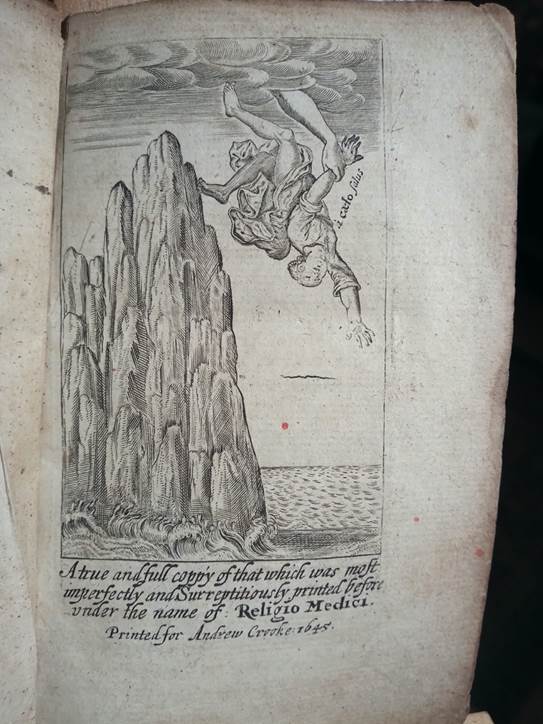
Frontispiece to Browne’s Religio Medici (1645)
This is the second of two editions issued in 1645 following the publication of the first authorised edition in 1643, and like 1643 it has no typographical title page. This reprints 1643, correcting only about a quarter of the errata and the sections are misnumbered as before. Keynes notes that the make-up of the book is different from the earlier issue of 1645 throughout and shows that the text had been set up afresh, with more modern orthography, so this is to be regarded as a separate edition.
Copies recorded in UK libraries: British Library; Cambridge University Library; King’s Lynn Library; Mitchell Library; Oxford: Bodleian Library, Worcester College; Manchester: John Rylands Library; The National Trust; Thomas Plume’s Library.
Related titles: The Works of the Learned Sr Thomas Brown (1686), Low PR3327.A1C86
— Browne, Thomas, Religio Medici. The fifth Edition, Corrected and amended. With Annotations Never before published, upon all the obscure passages therein. Also, Observations by Sir Kenelm Digby, now newly added (London: Printed by Tho. Milbourn, for Andrew Crook, at the Green Dragon in Pauls-Church-yard, 1659). 8vo. Wing B5174; Keynes 8.

This is the 1st edition to include Digby’s Observations, which has a separate title page, pagination and register, but according to Keynes this edition was never published separately. Stamp of the American Antiquarian Society, Worcester, Mass. on title page. Detached blank with ownership inscription of E. Parkman. A few annotations or corrections in an early hand.
— Browne, Thomas, Pseudodoxia Epidemica: or Enquiries into Very many received Tenets, and commonly presumed Truths (London: Printed by T.H. for Edward Dod, and are to be sold in Ivie Lane, 1646). 1st edition. Folio. Wing B5159; Keynes 73. Finely bound in modern full calf with morocco spine label. Ownership inscriptions of James Price 1795, Robert Price, and James Price 1844 on the title page. Annotations in an early hand on the initial blank and marginal annotations in the text.

— Brydges, Sir Egerton, The British Bibliographer, 4 vols. (London: Printed for R. Triphook by T. Bensley, 1810-14. Volumes 3-4 edited with Joseph Haslewood. Armorial bookplate.
Egerton Brydges (1762-1837) was a bibliographer, antiquarian and literary scholar. In 1810 he moved to Lee Priory, near Canterbury, home of his eldest son, where he established a private printing press and published many high quality, limited editions of earlier English literature, mainly from the Elizabethan/Jacobean era. He became a founder member of the exclusive bibliographical society, the Roxburgh Club, in 1812, but gave up the Lee Priory press in 1823. For Lee Priory publications see Elizabeth 1 1815; W. 1816. See also the printout of the Lee Priory Press section of Martin’s Bibliographical Catalogue of Books Privately Printed* and Phillips 1824.

From the Contents to Brydges’ British Bibliographer
Brydges’ Censura Literaria (see Related titles), which he says in the preface to volume 4 of the British Bibliographer was begun in 1805, might be seen as the first general anthology of English Renaissance literature, and it is extended in this work and in the Restituta, both of which add historical and critical comment to the pieces anthologised. The present work is divided into Poetry, Romances, Miscellaneous (essentially prose), Biography and Bibliographiana and opens with a biography of George Wither. In the preface to vol. 4 Brydges credits William Oldys (see Cooper 1741) with having initiated ‘the Bibliography of old English poetry’ and writes that ‘If ever a full Bibliographical Catalogue of English Literature, up to the close of the 17th century, which is at present a most important desideratum, shall be executed, the Censura Literaria, combined with the labours of Wood, Tanner, Ames, Herbert, Warton, and Dibdin, will go far in furnishing the necessary materials’.
Related titles: [works by Brydges] Lib Z2012.B8, Censura Literaria: Containing titles, abstracts, and opinions of old English books, 10 vols. (2nd edn. 1815); s PR1120.B8R4, Restituta, 4 [3] vols. (1816) [imperfect: lacks vol.1]; s DA506.B6, The Autobiography, Times, Opinions, and Contemporaries of Sir Egerton Brydges, 2 vols. (1834); The Poetical Works of John Milton, ed. Brydges (1848); [Lee Priory press publications of English Renaissance
Literature] r PR2343.G7E16, Fulke Greville, Lord Brook’s Life of Sir Philip Sydney (1816); rf PR2214.B4, Nicholas Breton, Breton’s Melancholic Humours (1815); s PR1232.Z90, William Browne, Original Poems, never before published (1815); s PR1205.L8D3, Francis Davison, Davison’s Poetical Rhapsody, [vol. 1] (1814), bound with Michael Drayton, Nymphidia: The Court of Fairy (1814) and Sir Henry Wotton, The Characters of Essex and Buckingham (1814-16); s Z1028.M2, John Martin, A Bibliographical Catalogue of Books Privately Printed, including those of the Bannatyne, Maitland and Roxburghe Clubs, and of the private presses at Darlington, Auchinleck, Lee Priory, Newcastle, Strawberry Hill, and Middle Hill (1834); [by the Lee Priory printer] s Z124.J6, J[ohn] Johnson, Typographia: or the Printer’s Instructor, 2 vols. (1824).
— Brydges, Sir Egerton, Restituta: or Titles, Extracts, and Characters of Old Books in English Literature, Revived, 4 vols. (London: Longman, Rees, Orme, Hurst, and Brown, 1814-16).

From the Contents to Brydges’ Restituta
— Buckingham, George Villiers, Duke of, A Key to the Rehearsal, or a critical View of the Authors, and Their Writings, That are expos’d in that Celebrated Play (London; Samuel Briscoe, 1704). Engraved frontispiece and plate; with The Rehearsal, As it is acted at the Theatre Royal by Her Majesty’s Servants (London, 1714). Separate engraved frontispiece and plate. ESTC N4649.
The original version of The Rehearsal was written by George Villiers, Duke of Buckingham, with possible contributions from Thomas Sprat, Samuel Butler, Martin Clifford, Edmund Waller and Abraham Cowley. It was first performed at the Theatre Royal in Drury Lane on 7 December 1671 and printed in 1672. There were nearly three hundred performances up to 1777. The ‘Key’ to the play was first printed in Samuel Briscoe’s 1704 edition.
Related titles: The Rehearsal [Bell’s edition) (1777), s PR1241.B4D77